

Entries by Lee Stuttaford

Queensland’s Healthcare Property Market Growth in 2026

Queensland's Healthcare Property Market Growth in 2026
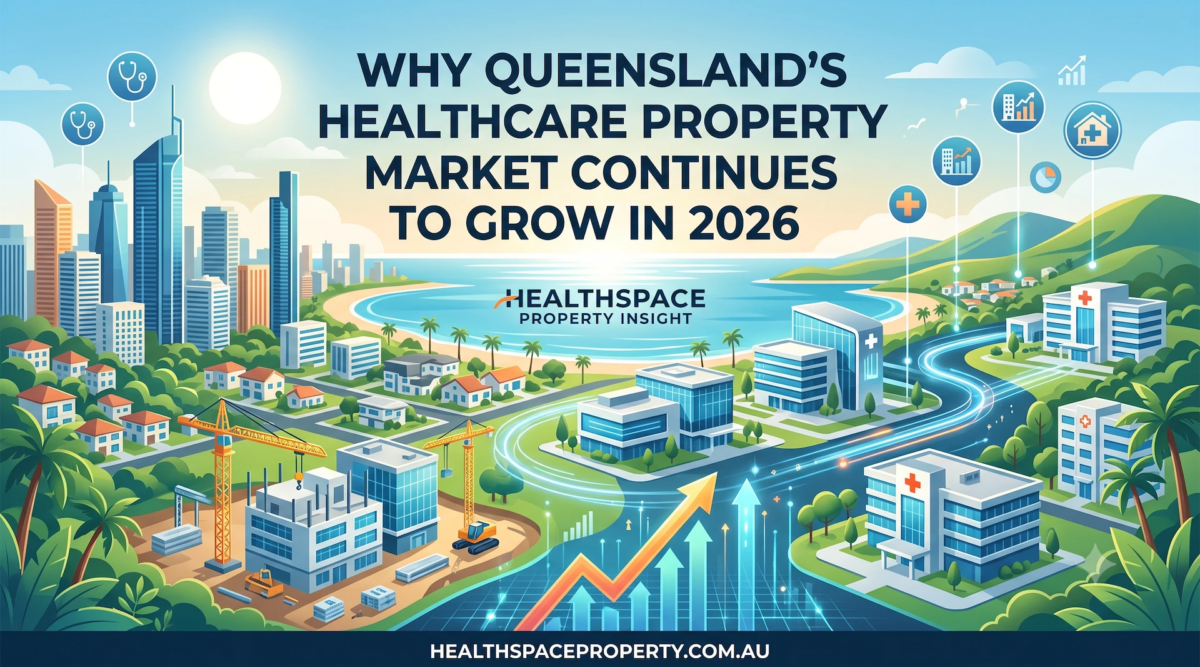
Healthcare property remains one of Queensland’s strongest-performing commercial sectors.

Demand for medical centres, specialist consulting suites and allied health facilities continues to grow, supported by population growth, significant investment in healthcare infrastructure and changing models of care. 

While broader commercial property markets continue to evolve, the long-term fundamentals supporting healthcare property remain strong.

For healthcare providers and landlords, understanding these trends is essential when making informed property decisions. Our Sales team helps clients navigate Queensland’s evolving healthcare property market with specialist advice. 

Here are five key factors shaping Queensland’s healthcare property market in 2026.


1. Population Growth Continues to Drive Healthcare Demand

Healthcare property has always been driven by one thing: People.

Queensland continues to experience strong population growth, fuelled by both an ageing population and ongoing interstate migration. As more people choose Queensland as a place to live, demand for healthcare services naturally increases.

An ageing population requires greater access to specialist care, chronic disease management and allied health services, while younger families create growing demand for general practice, paediatrics, dental care and women’s health.

For healthcare providers, this means expanding practices and increasing demand for well-located healthcare environments that can support long-term growth. Planning healthcare developments around these growth corridors requires a clear understanding of future demand, patient access and healthcare delivery. 

As Andrew, founder and director of Healthspace Property, explains:

“We aren’t just seeing retirees moving here anymore; we’re seeing young families as well. That creates demand across a broad range of healthcare services, from obstetrics and paediatrics in growth corridors to orthopaedics and specialist care in established communities.”

2. Public Healthcare Investment Is Creating New Opportunities

– Queensland continues to invest heavily in healthcare infrastructure through hospital expansions, new facilities and growing healthcare precincts.

– Major projects across Cairns, Townsville, the Sunshine Coast and the Gold Coast are creating opportunities for surrounding private healthcare providers.

– Where major hospitals expand, specialist consulting suites, radiology providers, pathology services, pharmacies and allied health businesses often follow.

– These healthcare precincts become established places where healthcare happens, creating long-term opportunities for both healthcare providers and property owners.

As Andrew explains:

“Public health investment often creates momentum for surrounding healthcare services. As new hospitals and facilities are delivered, we typically see increasing demand from private healthcare providers wanting to establish themselves nearby.”

3. Healthcare Is Moving Closer to Communities

Healthcare delivery continues to evolve. 

Many services that were once provided primarily within hospitals are now being delivered closer to where people live, making healthcare more accessible and convenient.

Medical centres, neighbourhood healthcare hubs and mixed-use healthcare developments are becoming increasingly common as providers seek locations that improve patient access and support collaboration among complementary healthcare services. 

As healthcare providers expand into new communities, securing the right location becomes just as important as the fit-out itself. This shift is creating demand for well-positioned healthcare properties across metropolitan and regional Queensland.

4. Healthcare Property Continues to Offer Long-Term Stability

Healthcare property has long been recognised as one of the more resilient sectors within commercial real estate.

Healthcare providers often establish long-term practices within their communities, making stability an important characteristic of the sector. Medical fit-outs represent significant investment, patient relationships are built over many years, and healthcare businesses generally prefer continuity rather than frequent relocation. 

Protecting those long-term relationships requires specialist management that understands the unique needs of healthcare tenancies. These characteristics continue to attract investors seeking stable, long-term assets supported by enduring demand for healthcare services.

5. Infrastructure Investment Is Expanding Healthcare Opportunities

The lead-up to the Brisbane 2032 Olympic and Paralympic Games continues to drive significant infrastructure investment across South East Queensland.

Transport improvements, road upgrades and growing communities are increasing accessibility across the region and opening new opportunities for healthcare development beyond traditional metropolitan centres.

As communities expand, demand for healthcare services grows alongside them, creating opportunities for new healthcare practices, specialist facilities and integrated healthcare precincts.

Looking Ahead

Queensland’s healthcare property market continues to be supported by strong demographic fundamentals, ongoing healthcare investment, and evolving care models. While every property decision should be considered on its own merits, the long-term outlook for healthcare property remains positive. 

At Healthspace Property, we believe healthcare property is about more than buildings. It’s about creating the places where healthcare happens. Whether you’re a healthcare provider planning your next practice, an investor considering healthcare property or a landlord seeking specialist advice, understanding the forces shaping the market is the first step towards making confident, informed decisions.

Healthcare property is different. Making informed decisions starts with understanding the market, the people it serves and the environments where healthcare happens.

That’s where specialist advice makes the difference. 


Article published 27 July 2026
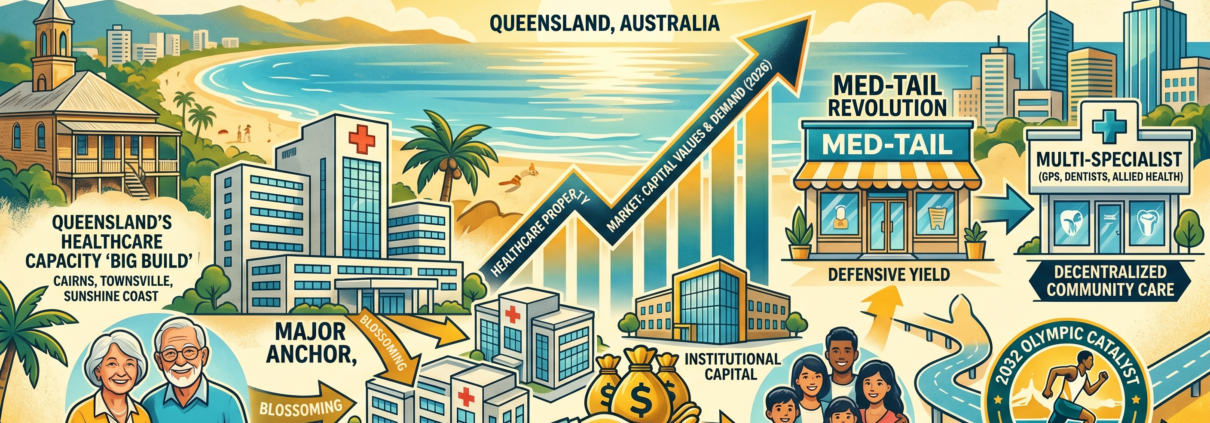
The “Silver Tsunami” Migration

The Demographic “Silver Tsunami” and Migration

While much of Australia’s commercial real estate market has spent the last five years recalibrating in the wake of shifting work patterns and economic headwinds, one sector in the Sunshine State has not just weathered the storm – it has positively thrived.

Queensland’s healthcare property market is currently experiencing an unprecedented boom. From state-of-the-art specialist centres in South East Queensland to integrated allied health hubs in regional corridors, the demand for medical-grade real estate is outstripping supply, driving yields down and capital values up. 

But this isn’t a sudden spike driven by speculative mania. 

Experts agree that the current boom is the culmination of several powerful, intersecting forces – demographic, governmental, and economic-that have made Queensland the most attractive market for healthcare investment in the country.

Here is why the healthcare property sector in Queensland is operating strongly in 2026.

The Demographic “Silver Tsunami” and Migration

The primary driver of healthcare demand is, and always will be, people. Queensland is currently benefiting from a dual demographic dividend that is placing immense pressure on health services. Firstly, the “ageing of the population” is no longer a future projection; it is a current reality. 

The large Baby Boomer cohort has fully entered their senior years, requiring exponentially more medical intervention, specialised care, and chronic disease management. Queensland, long a favoured retirement destination due to its climate and lifestyle, holds a disproportionate share of this demographic.

Secondly, the interstate migration boom that accelerated in the early 2020s has sustained into 2026. Thousands of residents continue to move north annually from New South Wales and Victoria, drawn by jobs, relative affordability, and the lead-up to the 2032 Olympics.

“We aren’t just seeing retirees moving here anymore; we are seeing young families. That creates a spectacular spectrum of demand-from obstetrics and paediatrics in growth corridors to geriatric care and orthopaedics in established coastal areas. You need physical brick-and-mortar space to deliver that care.”

– Andrew Deane, Founder & Director of Healthspace Property


The Government’s “Big Build” in Health

To meet this surging demand, the Queensland Government is midway through the most significant health infrastructure investment in the state’s history. The multi-billion-dollar Queensland Health Capacity to Serve program has seen massive expansions of major public hospitals in Cairns, Townsville, the Sunshine Coast, and the new Coomera Hospital on the Gold Coast.

Crucially, public investment acts as a powerful catalyst for private investment.

“Whenever a major public hospital expands, a private medical ecosystem blossoms around it too”, Deane explains. “Private specialists, pathology labs, radiology centres, and allied health providers all want to be within the immediate catchment of the major public anchor. This has created massive competition for commercial land and existing office space surrounding these hospitals, driving the ‘medical precinct’ phenomenon.”

Furthermore, the state government’s push for “satellite hospitals” in peri-urban areas has created new investment asset classes-smaller, community-focused facilities that lease space to various providers, offering stable, long-term returns for investors.

The “Med-Tail” Revolution and Evolution of Care

The nature of how healthcare is delivered has fundamentally changed, impacting the type of property required. There is a concerted shift away from treating everything within large, centralised hospitals towards decentralised, community-based care. This has given rise to the “Med-Tail” trend-healthcare operating in retail environments. 

Patients today demand convenience. Consequently, GPs, dentists, physiotherapists, and even specialised NDIS (National Disability Insurance Scheme) providers are taking up leases in neighbourhood shopping centres and strip malls.

For property owners, medical tenants are highly prized. They generally sign longer leases 5-10 years, have extremely low default rates, and are “sticky”-they rarely move because their patient base is localised and fitting out medical space is expensive. This makes retail or office space with medical approval far more valuable than standard commercial tenancies in 2026.

An Attractive Defensive Asset Class

From an investment perspective, the boom is fuelled by a “flight to quality” and stability. The economic volatility of the mid-2020s made traditional assets such as discretionary retail and secondary office space seem risky. 

Healthcare property, by contrast, is viewed as “recession-proof.” People require medical care regardless of inflation rates or consumer confidence. Institutional investors, including major superannuation funds and Real Estate Investment Trusts (REITs), have flooded the Queensland market, seeking the defensive yields that medical assets provide.

This wall of capital has compressed yields (increased property values) significantly. A purpose-built medical centre that might have traded at a 6% yield in 2021 is likely trading closer to 5.5% today, reflecting its premium status.

The 2032 Olympic Catalyst

Finally, the overarching influence of the Brisbane 2032 Olympic and Paralympic Games cannot be ignored. The massive infrastructure spend surrounding the games-cross-river rail, road upgrades, and new sporting precincts-is improving accessibility across South East Queensland centre. 

This infrastructure “boom within a boom” makes peripheral locations more viable for major medical hubs, expanding the geographic footprint of where investors can find value. It also guarantees sustained population growth for the next decade, assuring investors that the demand for health services will not taper off anytime soon.

The Outlook

As we look toward the second half of 2026, the Queensland healthcare property market shows few signs of cooling. While rising construction costs present a challenge for new developments, the desperate need for specialised space ensures that existing, well-located medical assets remain the crown jewels of the Queensland commercial property sector.

In 2026, in the Sunshine State, health isn’t just wealth – it’s a Gold Mine for Real Estate.
 
 
Article published 24 July 2026